GLS Joins Georgia Partners in Calling for Federal PBM Reform
Georgia Life Sciences is proud to stand with patient advocates, providers, and employers across the state in urging Congress to take meaningful action on pharmacy benefit manager (PBM) reform. We recently signed on to a joint letter to Georgia’s Congressional Delegation stressing the urgent need for transparency, fair practices, and policies that ensure savings flow directly to patients.
Atlanta, GA (April 1, 2026) – Georgia Life Sciences (GLS) is proud to announce that Saisurya Lakkimsetti, a junior at Lakeside High School in Columbia County, has been named the winner of the 2026 Georgia BioGENEius Challenge. The Georgia BioGENEius Challenge took place, as part of the statewide Georgia Science and Engineering Fair (GSEF) at the Classic Center in Athens, Georgia. Forty-seven students from across Georgia competed for this year’s title and cash prize. Jaehyeon Lee, an 11th-grade student from Walton High School, was named runner-up in this year’s competition. The Georgia BioGENEius Challenge recognizes outstanding high school students who are conducting innovative biotechnology research with real-world applications. This year’s top projects, presented in the Global Healthcare Challenge track, demonstrated exceptional scientific rigor and forward-thinking potential in addressing critical healthcare challenges. Saisurya’s research focuses on identifying potential inhibitors for Endocan, a protein known to play a role in glioblastoma tumor growth. Using advanced computational modeling techniques—including AlphaFold and molecular docking tools—she screened thousands of small molecules to identify compounds that may block tumor-promoting signaling pathways. Her work identified several promising candidates that could serve as a foundation for future drug development targeting glioblastoma. Jaehyeon’s project investigates how varying glucose concentrations affect regeneration in planaria, modeling impaired wound healing in diabetic conditions. By testing graded glucose environments and measuring regeneration indicators such as growth and differentiation, Jaehyeon demonstrated that lower glucose levels enhance regeneration while higher levels inhibit healing. The study establishes a model to better understand hyperglycemia’s impact on diabetic wound healing. “The work by these students is a powerful example of the innovation and determination we see in Georgia’s next generation of life sciences leaders,” said Maria Thacker Goethe, President and CEO of Georgia Life Sciences. “The BioGENEius Challenge is critical because it provides students with a platform to apply cutting-edge science to real-world problems, while also strengthening the future workforce that will drive breakthroughs in healthcare, biotechnology, and beyond.” The Georgia BioGENEius Challenge is part of Georgia Life Sciences’ broader commitment to advancing workforce development and fostering innovation across the state’s rapidly growing life sciences ecosystem. Judging the 2026 Georgia BioGENEius Challenge: Ian Biggs; Ralph Cordell, CDC; Alex Harvey, ViaMune; Jamie Graham, Smith Gambrell Russell; and Evan Scullin, LuminiSci.
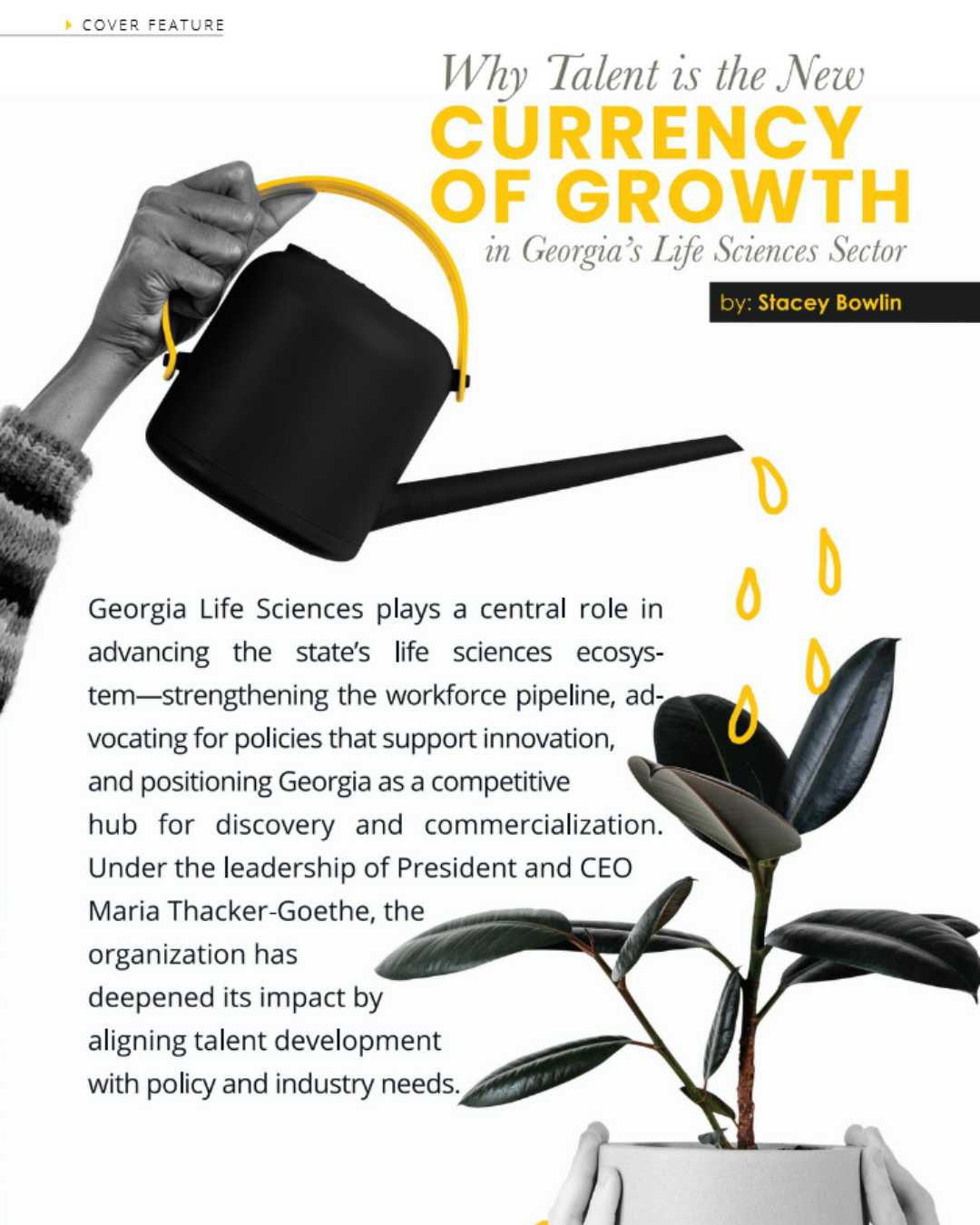
Georgia Life Sciences is thrilled to be featured in the very first Atlanta edition of Inside Medicine . This inaugural issue represents something truly special. Atlanta’s healthcare and life sciences community is driven by innovation, collaboration, and outstanding leadership—and we’re honored to be part of this exciting launch. Also in the issue, GLS's Kennedy Dumas is featured, sharing her journey on how observation and research evolved into a powerful practice of journaling. As the founder of Stationery Black, she creates notebooks designed to showcase, uplift, and inspire people of color. Read the full article here.
A new national outlook on the life sciences real estate market is reinforcing what many in Georgia’s ecosystem have been building toward: a more disciplined, workforce-driven, and manufacturing-focused future for the industry. CBRE’s 2026 U.S. Life Sciences Market Outlook points to a sector in transition—moving away from rapid, speculative expansion toward a more measured phase defined by targeted growth, capital efficiency, and long-term sustainability. For Georgia, these trends are not just informative—they are validating. A Market Reset Creates Opportunity After several years of rapid expansion in major coastal markets, the national lab space market is recalibrating. Construction has slowed significantly, and vacancy rates—while still elevated—are stabilizing. This shift favors emerging markets like Georgia that have taken a more measured approach to growth. Rather than contending with oversupply, Georgia is well-positioned to scale intentionally—aligning infrastructure, workforce, and industry demand in a way that supports long-term success. Manufacturing and Scale-Up Are Driving Growth One of the clearest signals from the CBRE report is the increasing role of large pharmaceutical and biomanufacturing investments in driving demand. This aligns directly with Georgia’s recent momentum. From major facility expansions to increased interest in onshoring and domestic production, the Southeast—and Georgia in particular—is becoming a destination for advanced manufacturing in the life sciences. The Georgia Life Sciences Roadmap has consistently emphasized this opportunity: Strengthening biomanufacturing capacity Building workforce pipelines to support production scale Positioning Georgia as a hub for both innovation and commercialization Workforce as the Differentiator As capital becomes more selective and companies prioritize execution, talent—not space—is emerging as the defining constraint. Georgia’s investments in workforce development, including partnerships with the Technical College System of Georgia and the Georgia Bioscience Training Center, position the state to meet this moment. Through coordinated efforts across education, industry, and government, Georgia is building the kind of workforce infrastructure that enables companies to not only locate here—but to grow here. A Converging Ecosystem Another key trend highlighted in the report is the convergence of life sciences with adjacent sectors such as digital health, robotics, and advanced technologies. This is an area where Atlanta stands out. With strengths in medtech, health IT, and data-driven healthcare solutions, the region offers a broader definition of “life sciences”—one that reflects where the industry is headed, not where it has been. Looking Ahead The national life sciences sector is entering a new phase—one that rewards strategic alignment, ecosystem coordination, and long-term investment. Georgia is not starting from scratch in this environment. It has been building toward it. The Georgia Life Sciences Roadmap anticipated many of these shifts, prioritizing: Workforce development Manufacturing and scale-up capacity Industry-academic collaboration Capital and commercialization pathways As national trends continue to evolve, Georgia’s focus on disciplined, intentional growth positions the state—and the broader Southeast—as a compelling partner in the next chapter of the life sciences industry. Read report - CBRE Chapter 9, Life Sciences - U.S. Real Estate Market Outlook 2026 https://www.cbre.com/insights/books/us-real-estate-market-outlook-2026/life-sciences